Giulliani lauds ‘Herculean’ effort to build counter-UAS systems
By DRONELIFE Features Editor Jim Magill
(Editor’s note: This story is part of a series of reports on efforts to establish new counter-UAS protocols in the U.S. to protect high-profile sporting events and critical infrastructure from the potential threats posed by drones flown by careless or hostile actors.)

In the little over a year that has passed since he was named as executive director of the White House Task Force on the FIFA World Cup 2026, Andrew Giuliani has presided over the “Herculean” effort to ensure the tournament celebrating the “beautiful game” goes off without a hitch.
In an interview with DRONELIFE, Giuliani, the son of former New York Mayor Rudolph Giuliani, said the scope of the challenge of providing counter-UAS protection for the tournament events held for 40 days across 11 U.S. cities has been massive.
“All 78 matches will have counter-UAS mitigation by the feds. And each fan festival in each city for the duration of the tournament will have counter-UAS mitigation proscribed by the task force model created out of the Safer Skies Act,” he said.
President Trump named Giulliani to head up the task force on May 6, 2025. Since that time, Giulliani has coordinated with FIFA, federal government agencies – including the FAA, the FCC, the FBI and Joint Interagency Task Force 401, the Pentagon’s central authority for coordinating drone and counter-UAS operations – and state and local law enforcement agencies to ensure that the airspace above World Cup activities is free of incursions from unwanted drones.
Giuliani pointed to the Restoring American Airspace Sovereignty executive order, which Trump signed on June 6, 2025, as kicking off the federal government’s push to rapidly establish a framework for a nationwide collection of counter-drone systems.
This event was followed by a series of governmental actions to pave the way for counter-UAS operations on a national scale: “the passing of the Safer Skies Act, which of course ended up creating a pathway for state and local law enforcement to be able to mitigate, and the creation of the FBI schoolhouse, where state and locals went to be able to gain the training necessary to be able to mitigate against these drones,” he said.
He noted that the Department of Justice has done its part by deputizing some 60 state and local law enforcement officers, which along with their attendance at the FBI’s National Counter-Unmanned Aircraft Systems Training Center, qualifies them to operate drone-mitigation technologies in their respective jurisdictions. In addition, he noted the One Big Beautiful Bill, which Trump signed into law on July 4, 2025, provided the funding for a $500 million counter-UAS grant program.
“And the first $250 million of that is being used for fiscal year 2026. Understand, that’s all going to the national capital region and the 11 states that are hosting FIFA and FIFA-adjacent events,” Giulliani said.
All that hard work and investment has greatly expanded the federal government’s ability to provide security at high-impact events. In 2025, officials were only able to provide the level of protection seen at the annual Super Bowl game at five events, each given a Special Event Assessment Rating (SEAR) rating by the U.S. Department of Homeland Security (DHS).
“We’ve been able to ramp up to this degree where you’ll have over 150 different events just for the World Cup covered by counter-UAS,” he said.
Drone mitigation measures remain closely guarded information
“We’ve gamed out scenarios and we’ve done, I think, everything that we can over the last year to be able to address all the different security measures. That way we can keep Americans who gather together for this World Cup and frankly, all the Freedom 250 events — all the great events around America’s semi-quincentennial — safe from the skies,” he said.
Giulliani said that in planning counter-UAS security measures at event sites, federal officials have had to account for the presence of UAVs operated by two types of pilots, hobbyists seeking to collect cool photos and videos, and those seeking to use a drone for more nefarious purposes, or “idiots and evildoers.”
For the former group, he warned that drone pilots should pay attention to and abide by FAA flight restrictions imposed above areas that serve as sites for World Cup-related events.
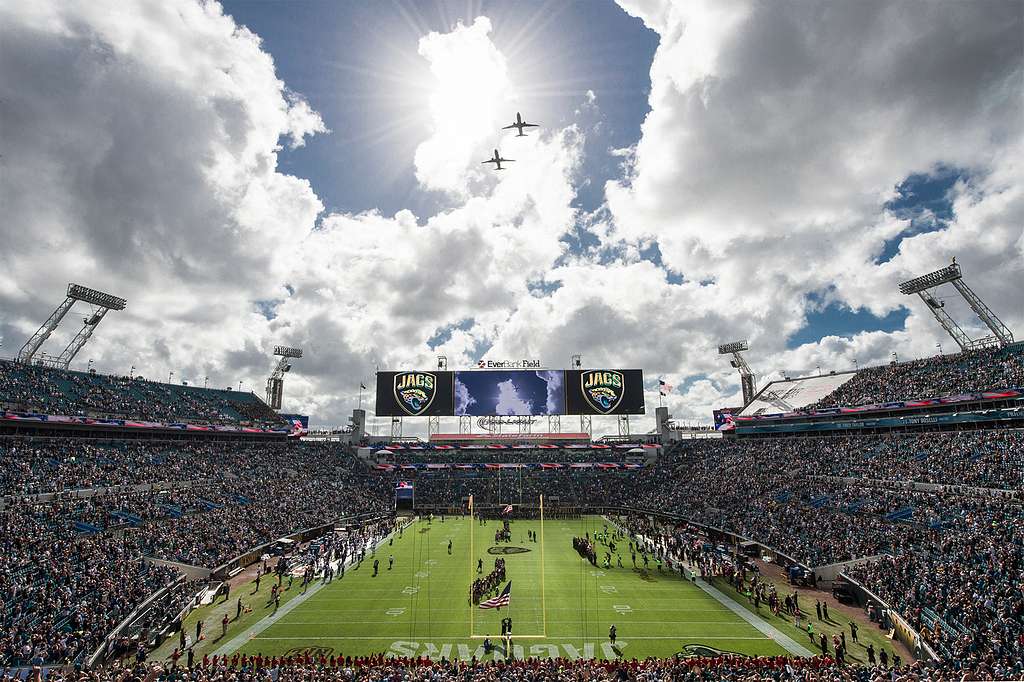
“We want to be very clear for people that may be flying their drone in the area of the stadium, that there’s going to be a three-mile temporary flight restriction on game days. So, don’t fly your drones,” he said.
“There is a zero-tolerance policy. It’s a no-drone zone. We don’t want your drones out there and we’ll confiscate it and you’ll get fined if you end up doing that.”
Security planners have also taken steps to protect against any actor who wishes to use a drone to cause harm or chaos at one of the events. Citing security concerns, Giulliani declined to discuss what specific drone-mitigation modalities would be deployed at FIFA-related sites.
“What I can tell you is there are multiple mitigation measures out there for federal law enforcement,” he said. Federal agencies, such as the FBI, Customs and Border Protect and the Federal Protective Service are working with police departments in FIFA host cities, such as Atlanta, New York City and Seattle, to provide drone-mitigation protections at World Cup-related sites.
Government shut-downs caused some delays
The World Cup Task Force faced many challenges on its path to ensuring the safety and security of all FIFA related venues, including two government shutdowns, which lasted a combined 119 days and which delayed DHS from distributing counter-UAS funds to the recipients in the host cities entitled to them.
“I’m so proud of the planning out of the Department of Homeland Security, considering that for over three months, close to four months, they were planning with one hand tied behind their back,” Giulliani said.
“I could see the integrity and the work ethic that so many of the people that I work with, by showing up to the office every single day with the mission set in mind, even though they weren’t getting paid, even though there were stresses in their personal life.”
Recently, some high-ranking federal officials have expressed concern that the nation might not be fully prepared to provide counter-UAS protections at all World Cup-related events. On June 3, U.S. Secretary of Homeland Security Markwayne Mullin testified at a hearing of the U.S. House Homeland Security Committee that federal security agencies and their partners were “a little behind” in standing up counter-UAS capabilities at all sites in U.S. cities hosting FIFA World Cup tournament events.
However, Giuliani insisted that the U.S. is ready and that Mullin’s remarks were reflective of him taking a more historic perspective on the issue.
“I think he’s looking at the picture of how little was done in the previous administration,” he said. “I know Secretary Mullin is extremely focused on doing everything he can to protect Americans in every way he possibly can.”
Giuliani said he has been extremely impressed by the incredible work done by DPS and other agencies of the federal government in regard to establishing counter-UAS capabilities at FIFA-related sites. “It’s been nothing short of I don’t want to say miraculous, right? But it’s been Herculean.”
Read more:

Jim Magill is a Houston-based writer with almost a quarter-century of experience covering technical and economic developments in the oil and gas industry. After retiring in December 2019 as a senior editor with S&P Global Platts, Jim began writing about emerging technologies, such as artificial intelligence, robots and drones, and the ways in which they’re contributing to our society. In addition to DroneLife, Jim is a contributor to Forbes.com and his work has appeared in the Houston Chronicle, U.S. News & World Report, and Unmanned Systems, a publication of the Association for Unmanned Vehicle Systems International